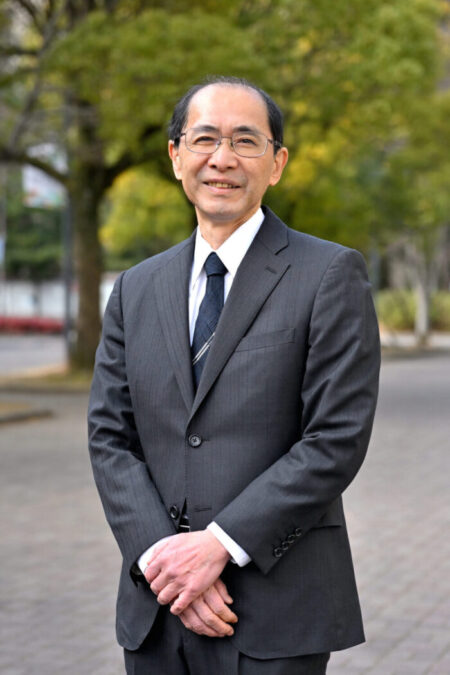
I have the honor of assuming the position of the 14th President of Saitama University and leading the university into the future. I will do my utmost to ensure that Saitama University continues to develop, and I am fully committed to this responsibility.
Saitama University was established in 1949 as a national university under Japan’s postwar education reform through the merger of the former Urawa Higher School, Saitama Normal School, and Saitama Youth Normal School. More than 75 years have passed since then, and the university has evolved into a university that has five faculties—Liberal Arts, Economics, Education, Science, and Engineering—and three graduate schools—Humanities and Social Sciences, Education, and Science and Engineering—all located on a single campus.
Our “All in One Campus” concept is not merely a matter of physical proximity. Comprising the three major academic disciplines of the humanities, social sciences, and natural sciences, from foundational to practical levels, and equipped with a Faculty of Education dedicated to nurturing the next generation of teachers, our university inherently provides an environment that fosters deep “disciplinary knowledge” while simultaneously cultivating “integrated knowledge” that connects these fields. Daily dialogue and collaboration across fields generate new perspectives and cultivate the ability to view society from a broader perspective.
In recent years, rapid advances in AI and data science have begun to impact not only research methodologies and industrial structures, but also the very way humans think. Meanwhile, protracted international conflicts and the erosion of freedom, democracy, and other universal values are raising profound questions about the nature of world order and solidarity. In today’s world in which uncertainty and division are increasing at the same time, gathering fragmentary knowledge is insufficient to grasp the essence of society. What is required is both deep disciplinary knowledge and a perspective capable of integrating that knowledge.
By “integrated knowledge,” we mean the intellectual ability, grounded in thorough disciplinary knowledge, to integrate insights across fields, structurally understand complex issues, and devise sustainable solutions. The nurturing of individuals who, through the dynamic interplay between disciplinary knowledge and integrated knowledge, formulate their own questions and collaborate with others to forge a path toward the future is the pillar of our university’s education.
In our research, more than anything, we value free and original inquiry. True innovation that transforms society is not generated from the accumulation of short-term results, but rather, it takes root in the steady accumulation of fundamental research conducted with a long-term perspective. We regard the deepening of fundamental research as the cornerstone of academia and will strengthen our framework to expand applied research and link it to practical implementation in society. Moreover, we will aggressively promote cross-cutting research that integrates the humanities and sciences to address increasingly complex social challenges. It is precisely where different fields of knowledge intersect that new ideas and practical solutions are born. We will strategically tackle diverse challenges, such as environmental and energy issues, the advancement of regional industries, educational reform, and the realization of a welfare-oriented and inclusive society, from both fundamental and applied perspectives, as well as specialized and interdisciplinary approaches, and we will return the results of these efforts to society.
Our university is in Saitama Prefecture, which has developed as a hub for wide-area logistics, leveraging its geographical advantage as a key junction in the East Japan transportation network, and it is a region where inland industries, centered on advanced manufacturing, are concentrated. At the same time, it also has a vibrant agricultural sector with suburban farming producing branded agricultural products such as Fukaya spring onions and Sayama tea. Furthermore, blessed with abundant natural beauty, including the Chichibu area, as well as rich historical and cultural resources, the region boasts a diverse local community where multicultural coexistence is increasing. As the only national university in the prefecture, Saitama University supports the region’s sustainable development through its intellectual resources, in collaboration with businesses and local governments and through participation in policy-making. Moreover, by promoting international joint research and intercultural collaborative learning, we will fulfill our role as a hub that connects the region to the world.
We have systematically established support services for students that include academic, career, and mental health support, while also creating a welcoming environment where all students, including students with disabilities and international students, can study with peace of mind. Diversity, Equity, and Inclusion (DEI) is not merely a temporary ideal, but a set of universal values shared worldwide and the foundation of a sustainable society and academic community. Our university is committed to upholding these values and respecting one another’s differences while building a campus that can transform diversity into a source of creativity.
We promote data-driven decision-making and appropriately utilize new technologies, such as generative AI, while enhancing rationality and transparency in university management. We also strive to secure stable funding and establish a sustainable management foundation to fulfil our responsibility to future generations.
The Kamakura-period Buddhist monk Myoe left us the phrase “Arubekiyōwa,” meaning “to be as one ought to be.” This teaching encourages us to ask ourselves, “How should I live?” in this moment and in this situation, and to live in accordance with that answer. It offers profound insights as we consider the mission of the university. Now, as society reexamines the role of universities, we are required to discern what is essential, to preserve what must be preserved, and to change what must be changed.
What is the ideal state for Saitama University? It is to be a university that brings together the integrative power of knowledge, with education and research as its two pillars, connecting the local community to the world, and fostering the next generation of leaders and teachers who will support future education. With this mission in mind, we will work together with all of you to shape the future. I sincerely ask for your continued understanding and support.
Takaomi Shigehara
President, Saitama University

 ResearchAdmissionAcademic ProgramsExchange ProgramsStudent Life
© Copyright Saitama University, All Rights Reserved.
 Menu
Menu Home
Home Japanese
 Current Students
 by User
 Contents