2026/11/11
Full article (PDF)
Key Points
Direct involvement of reactive oxygen species in heat inactivation of photosynthesis
We found that, at high temperatures, large amounts of reactive oxygen species (ROS)(1) are generated by the electron transport system of photosynthesis(2). These ROS directly damage photosystem II (PSII)(3) and inhibit protein synthesis(4).
Synergistic effects achieved by simultaneously enhancing the antioxidant defense and protein synthesis capacity
By simultaneously overexpressing ROS-scavenging enzymes (superoxide dismutase [SOD] and catalase)(5) and a modified, oxidation-resistant translation elongation factor (EF-Tu)(6), we successfully mitigated structural damage to PSII at high temperatures while maintaining a high level of synthesis of the D1 protein(7), which plays a central role in PSII repair(8).
A pathway toward biomanufacturing in harsh environments and increased crop production
We demonstrated dramatic improvements in overall photosynthetic activity and survival at high temperatures. The findings are expected to help overcome the growth inhibition of microalgae caused by rising water temperatures in outdoor cultivation ponds during summer, enabling stable production of biofuels and valuable bioproducts, and potentially contribute to improved heat tolerance in crops.
A B
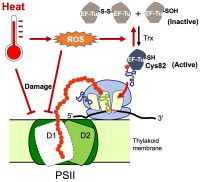
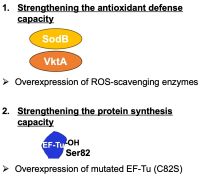
Figure 1. (A) Relationship between heat damage to photosystem II (PSII) and reactive oxygen species (ROS). (B) Strategy for acquiring thermotolerance by simultaneously enhancing the antioxidant defense and protein synthesis capacity.
Overview
Professor Nishiyama and his colleagues, Graduate School of Science and Engineering, Saitama University, have developed a method to substantially improve the high-temperature tolerance of photosynthesis using cyanobacteria(9), a model microalgal organism.
Photosynthesis is extremely sensitive to heat, and photosystem II (PSII) is rapidly inactivated under heat stress. In this study, the researchers simultaneously strengthened an enzymatic system that eliminates intracellular reactive oxygen species (ROS) and the protein synthesis system (involving the translation factor EF-Tu) required to repair heat-damaged PSII. This provided “dual protection” by physically stabilizing PSII against heat-induced damage while maintaining a rapid repair cycle. As a result, they markedly suppressed the decline in photosynthetic activity at high temperatures and successfully improved the growth and survival of cells.
The findings were published online in the international plant science journal Plant and Cell Physiology on November 11, 2026.
Title: Simultaneous reinforcement of the antioxidant defense and translational systems enhances the thermotolerance of photosystem II in Synechocystis sp. PCC 6803
Authors: Pornpan Napaumpaiporn, Rattanaporn Songserm, Anchalee Sirikhachornkit, Yoshitaka Nishiyama* (*Corresponding author)
DOI: 10.1093/pcp/pcag148
URL: https://academic.oup.com/pcp/article-lookup/doi/10.1093/pcp/pcag148
Publication Information
|
Journal |
Plant and Cell Physiology |
|
Title |
Simultaneous reinforcement of the antioxidant defense and translational systems enhances the thermotolerance of photosystem II in Synechocystis sp. PCC 6803 |
|
Authors |
Pornpan Napaumpaiporn, Rattanaporn Songserm, Anchalee Sirikhachornkit, Yoshitaka Nishiyama* (*Corresponding author) |
|
DOI |
10.1093/pcp/pcag148 |
|
URL |
https://academic.oup.com/pcp/article-lookup/doi/10.1093/pcp/pcag148 |

 ResearchAdmissionAcademic ProgramsExchange ProgramsStudent Life

© Copyright Saitama University, All Rights Reserved.

 Menu
 Home
 Japanese
 Current Students
 by User

 Contents